
Resources
This item is one of over 25,000 physical resources available from the Resources Collection. The Archive Collection covers over 50 years of curriculum development in the STEM subjects. The Contemporary Collection includes all the latest publications from UK educational publishers.
Sort It Out is a pack of line drawings on cards which show:
- the sources of raw materials
- the processes involved in the production of goods
- the variety of ways in which products are sold to consumers
The pack also includes a teacher guidance booklet.
This item is one of over 25,000 physical resources available from the Resources Collection. The Archive Collection covers over 50 years of curriculum development in the STEM subjects. The Contemporary Collection includes all the latest publications from UK educational publishers.
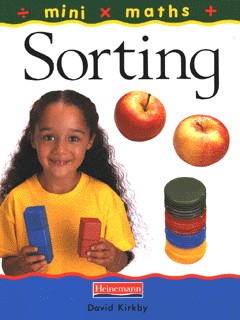
One of a series designed to introduce basic mathematical concepts to young children. Each concept is covered by a double-page spread which shows it being used in everyday life and aims to reinforce the child's...
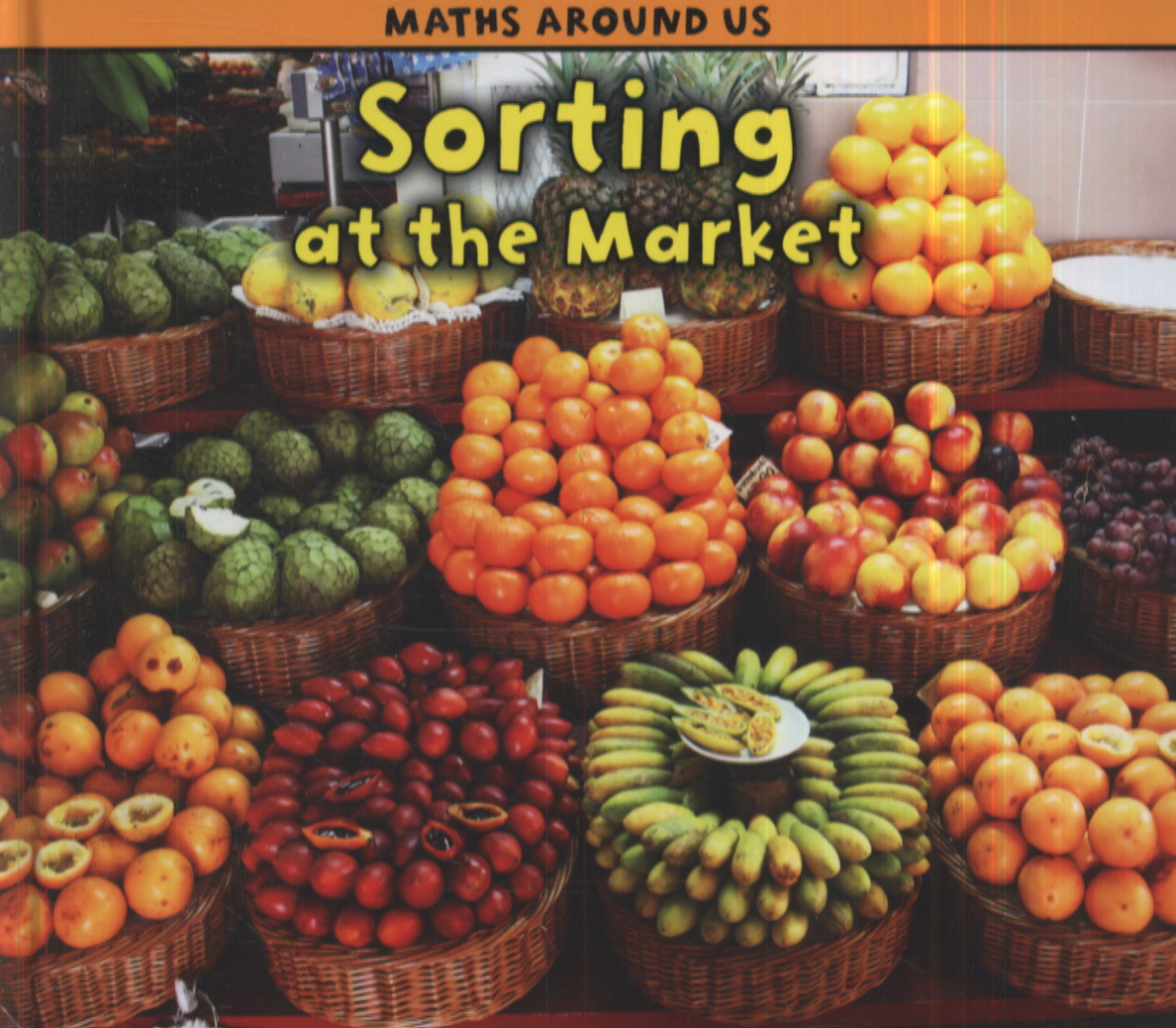
This title uses simple text and vivid images to introduce readers to different ways objects can be sorted.
This booklet is a sequel to Sorting by Symmetry: Patterns with a Centre. As with the earlier book, you will need squared paper, tracing paper and hand mirrors for the suggested activities.
Bob Burn has gathered a collection of diagrams and geometric objects. Sorting is a natural human activity and here the collection is sorted by symmetry. Choose some favourite symmetrical objects to sort alongside the figures in the first few sections and recognise the groupings for yourself.
Careful...
Sorting equations and identities
This resource looks at the concept of recognising the differences between equations and identities. Students substitute numbers into algebraic statements in order to test their validity. Common errors are highlighted that can occur when manipulating expressions.
Students work on an exercise that involves...
Sorting equations of circles 1
This lesson develops the concept of using Pythagoras’ theorem to derive the equation of a circle and translating between the geometric features of circles and their equations.
The initial activity involves looking at a circle with end points of the diameter at (6, 0) and (–6, 0). Questions relate to...
Sorting equations of circles 2
This lesson develops the concept of using the equation of a circle. In particular students develop their knowledge of how to:
- Translate between the equations of circles and their geometric features
- Sketch a circle from its equation
In the introductory activity a circle has been...