
Resources
Double Brackets
This activity, for two players, is based upon the game of boxes. Students are presented with a partially completed game, with double brackets to expand correctly in order to gain extra edges. Solutions are at the bottom of the page for a player's opponent to check the validity of the solution. A correct answer...
The Double Crossed project was developed by the Centre for Science Education and supported by the Astra Zeneca Teaching Trust as a collaboration between science and history teachers to produce cross-curricular resources.
The project aim was to make science learning more accessible, effective and enjoyable by...
Developed by the Centre for Science Education and supported by the Astra Zeneca Teaching Trust, the Double and Triple Crossed projects aimed to bring science and history together to increase engagement in science through topic based, contextualised learning.
The project enabled thirteen science and history...
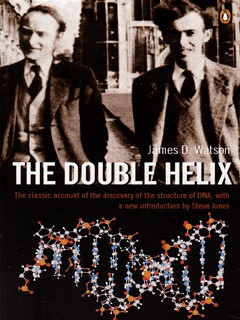
The greatest achievement of science in the twentieth century ... It will be an enormous success, and deserves to be so - a classic in the sense it will go on being read' - Sir Peter Medawar Francis Crick and James...
Double helix images
A series of images representing double helix images.
- DNA double helix and sequencing output: molecular model of a DNA double helix showing the individual atoms (apart from hydrogen) as coloured balls. Carbon atoms are in white, oxygen in red, phosporus in purple and nitrogen in blue....
In these 4 lectures, HHMI president and Nobel laureate Thomas R. Cech explains the role of RNA in cellular biology. He also discusses other implications of RNA catalysis. Lectures were given in 1995.
Double-slits and diffraction
This kit and their associated resources are designed to help teach about double-slit and diffraction patterns.
Before teaching this, students should:
- be familiar with constructive and destructive interference;
- be aware that we get diffraction when a wave travels through a gap;
- ...
Doubling and Dabbling in Duckweed
Produced by Science & Plants for Schools (SAPS), the investigations suggested in this resource use duckweeds. These seem to be simple plants - small, green, and with no flowers. However, this simplicity makes them ideal experimental organisms for investigations into...
An exciting and colourful resource to enhance and reinforce the understanding of basic mathematical calculations and number sense. Presents calculation problems and step-by-step guides that explain how to solve them...